

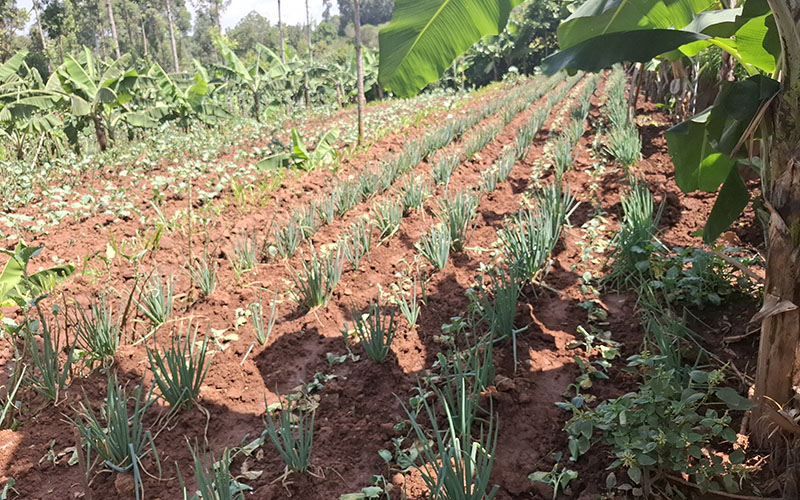
Last month, while engaging the Givole Farmers Group in sustainable agricultural practices, I was once again struck by a familiar reality: over 90% of the participants were women. It’s something I notice every time—and yet, it never stops stirring something in me. These women were thirsty for knowledge and keen to learn. As is our monthly ritual at IGAC, we explored agroecology and climate-smart agricultural practices that could turn around the livelihood status of our communities. The excitement was infectious as we walked through their exemplary demonstration farm. Picture this: a farm with lush banana trees casting their shade over rows of spring onions planted in raised beds. Vegetables intercropped with legumes to enrich the soil. Herbs incorporated into the beds to manage pests. A gravity-powered irrigation system channeling water efficiently through the beds. Fruity trees standing guard on the edges. It’s a vibrant, illustrious green classroom telling a story of adaptability and resilience.
As we concluded the session, Mama Mmboga noted, ‘I have learnt so much during the sessions, but unfortunately it ends here’. Not fully grasping what she meant, I inquired further. How do you mean? “My husband says, ‘If our fathers farmed this way, why change?’” She explained. “The land is in his name. If I try new things without his approval, there will be trouble.” Other women in the group joined in and echoed her sentiments. The excitement was replaced with a moment of silence as the statement settled heavily in my spirit and I tried to digest this painful truth.
These women, who are the stewards of the soil, do not own the land they till. Access to the land is conditional and at the mercy of their husbands, fathers, or brothers. It is the women who gain the knowledge and skills, but when it’s time to transfer this knowledge to their actual farms, they hit a brick wall. They have to seek permission from men who have not engaged in any learning session and who dismiss what they do not understand. The majority of the women noted that their men were keen on traditional farming systems.
The result? Innovation and adaptation die at the gate of tradition. The households remain stuck in outdated, low yielding practices. This means food insecurity. Low income generation. And the poverty cycle continues.
The Law vs Culture; A System Struggle Backed by Data
Sadly, this story is not unique to these women. It reflects a larger systematic barrier facing millions of women across Kenya. Although women contribute approximately 80% of agricultural labor in Kenya, women are largely exempted from land ownership as shown below;
- Sole Ownership by Women; Only 5% of Kenyan women hold land titles in their name alone(KNBS, 2019).In rural areas, as few as 1–5% own land individually, especially under customary systems (World Bank, 2021).
- Agricultural Land Access; Less than 30% of women have documented ownership or control of farmland(Kenya Land Alliance, 2022).70–75% rely on male relatives (husbands, fathers, or sons) for access to agricultural land (UN FAO, 2020).
- Non-Agricultural (Urban/Commercial) Land; Fewer than 10% of women own urban/commercial property(FIDA-Kenya, 2021). Only 7% of urban women hold independent titles (KNBS, 2019).
- Joint Ownership (Husband & Wife); Just 5–15% of land titles are jointly registeredby spouses (Ministry of Lands, 2023).
These numbers are not just facts; they reflect systematic barriers to food security, household resilience, economic dignity, and generational change.
What the Law Says BUT Culture Silences
The Constitution of Kenya (2010) is very clear and provides a rock-solid foundation for gender equality in matters land rights. The constitution explicitly calls for the elimination of gender discrimination in access to land. It stipulates that all Kenyan citizens have a right to own property. Additionally, the Land act of 2012 supports spousal consent and promotes joint land ownership.
But as is the norm in our country, women are protected on paper but not in practice. As we famously say in Kenya, “Kwa ground vitu ni tofauti“, meaning customary practices still dominate. In most instances, land is passed down through male lineage under the guise that women will get married and so have no need to own land. In other instances, where women own land, they are pressured to relinquish it to male relatives. In these instances, the unspoken patriarchal grasp renders the legal framework toothless. The Heart-wrenching truth is that only 5% of women in Kenya hold deeds individually despite the Succession Act giving wives and daughters the same legal rights as sons to inherit land.
But there are glimpses of hope. In Givole village, after an IGAC community dialogue challenging customary norms, a father of four handed over the management of his land to his wife—a trained agroecology farmer. Applying her knowledge, she shifted from the common maize farming to integrated farming of vegetables, poultry and fish. This tripled their harvest. Today, the family supplies vegetables and eggs to a local hotel through an aggregator group. This is one of many stories we are rewriting. Change is possible: one individual, one community, one county at a time.
IGAC’s contribution
At I Grow Africa Centre (IGAC), we believe knowledge should lead to transformation, not frustration. In addition to training communities on sustainable agriculture, we are leading advocacy work on inclusive land access, conducting community dialogues that unpack cultural norms around land use and gender norms, and co-learning models that incorporate men in the conversation. As allies, men are likely to support what they understand
Bridging the Gap
Unlocking the potential of our communities starts by first listening to their quiet truths and needs.
How then do we bridge this systemic gap? It is by each of us taking one intentional step in the right direction because collective change beings with individual action.
For policymakers and government institutions, faithfully enforce women’s right to land ownership by establishing and strengthening customary land tribunals and supporting land titling to women.
For the community, take a step forward and challenge the customary patriarchal customs that deny women equal inheritance rights and access to land.
For Fathers, brothers, and sons-land is more than soil. It is security. It is dignity. It is a lifeline. When you deny your daughter, your wife, your sister the right to inherit or access land, you take away their power, their lifeline, their future, and that of her generation. Be the man who breaks the cycle.
For donors and partners, this work needs you. Allocate resources to programs that recognize land as an enforcer of gender equality. Let’s have those difficult conversations at all the levels. Let us scale up community sensitizations and extend legal aid to women to achieve their rights. For every $ 100, IGAC can train 10 families on co-ownership or support a community dialogue. To fund a dialogues session or a land-rights workshop, write to us programs@igac.co.ke. Change begins when knowledge meets opportunity.